

Global Broker Regulation Inquiry App
About WikiFX
English
简体中文
繁體中文
English
Pусский
日本語
ภาษาไทย
Tiếng Việt
Bahasa Indonesia
Español
हिन्दी
Filippiiniläinen
Français
Deutsch
Português
Türkçe
한국어
العربية
اردو


How to Spot a Safe Forex Broker: 3 Checks Every Beginner Must Do

WikiFX
|


Abstract:This article explains the essential factors for choosing a legitimate forex broker, including regulation, trading costs, and withdrawal reliability. It includes a hypothetical cost comparison to illustrate how to evaluate spreads and commissions, and warns against common pitfalls like chasing the lowest spread or ignoring regulatory jurisdiction.
 Contents
What Makes a Broker Trustworthy?
A forex broker is the intermediary that gives you access to the currency market. Without a broker, you cannot trade retail forex. But not all brokers are equal. Some operate under strict rules that protect your investments, while others can vanish with your deposit. The difference lies in regulation, cost transparency, and business practices. Regulation means that a government authority watches over the broker, enforces capital requirements, and keeps client funds separate from the company‘s capital. For a beginner, the safest starting point is a broker licensed by a top‑tier regulator such as the UK’s Financial Conduct Authority, Australia‘s ASIC, or Cyprus’s CySEC. These bodies require segregated accounts and often provide compensation schemes if the broker fails. Yet many new traders only look at flashy ads or low spreads and skip the research step entirely.
The Three‑Point Checklist for Beginners
Here are three concrete checks that can immediately filter out risky brokers.
- Regulatory status verification. Go to the regulator‘s website and search the broker’s license number. Confirm the license covers forex trading and that the broker is not a clone firm. A badge on a website is not proof; you must verify independently. Even large, well‑known brokers should be checked this way.
- Total trading cost per trade. The spread is the difference between the buy and sell price of a currency pair. It is the most common trading cost. Some brokers charge a commission on top of a low spread, while others offer a wider spread with no commission. To compare, calculate the combined cost for a standard trade size. That figure, not the headline spread, tells you what you will actually pay.
- Withdrawal experience. Search forums and review sites for complaints about delayed or denied withdrawals. A broker that makes deposits instant but withdrawals painful should be avoided. Read the terms on withdrawal processing times and fees as well.
A Realistic Cost Example (With Numbers)
Hypothetical scenario for illustration only. Assume you trade one standard lot (100,000 units) of USD/CAD. The exchange rate is roughly 1.40, close to recent market levels. A pip, the smallest price change most currency pairs use, is 0.0001. Because the quote currency is Canadian dollars, the value of one pip in US dollars is (0.0001 / 1.40) × 100,000 ≈ $7.14. Compare two imaginary brokers:
- Broker X: spread 0.1 pips, plus a round‑turn commission of $7 per lot.
- Broker Y: fixed spread 1.2 pips, no commission.
Now calculate the round‑turn cost:
- Spread cost Broker X: 0.1 × $7.14 = $0.71
- Spread cost Broker Y: 1.2 × $7.14 = $8.57
- Total cost Broker X: $0.71 + $7.00 = $7.71
- Total cost Broker Y: $8.57
In this constructed example, Broker X appears cheaper overall. But note: spreads often widen during news and volatile hours. Commission alone may not capture the true cost if execution suffers. You could face slippage that adds hidden expense. Slippage happens when your order is filled at a different price than expected because the market moved. The exercise demonstrates that a single number, like the advertised spread, is not enough. You must calculate with your own typical trade size and compare total round‑turn costs.
This is a teaching example. No real broker is named, and no recommendation is implied.
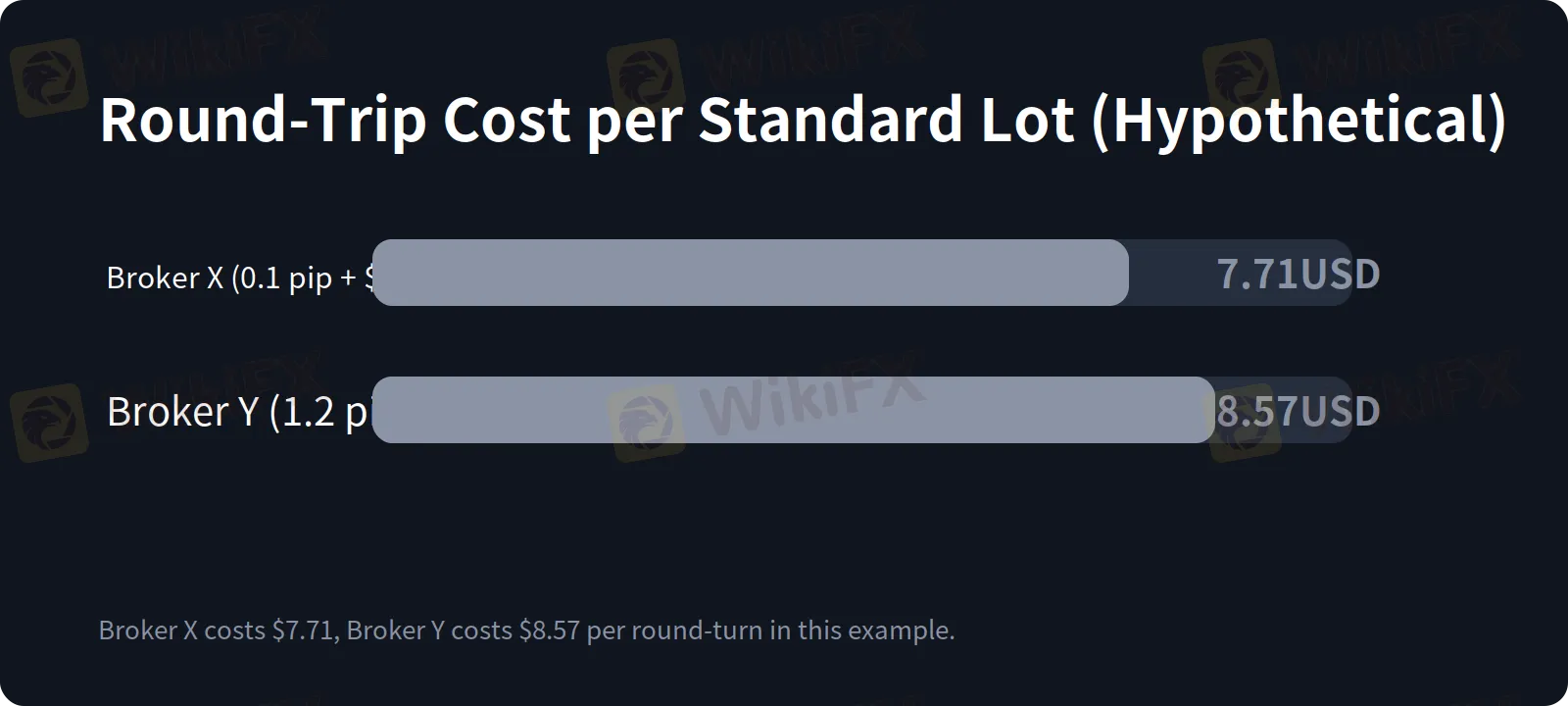
Hypothetical cost comparison. Real costs depend on market conditions and trade size.
From Searching to Verifying
Beginners often choose a broker by the lowest spread they see on a comparison site. That is a mistake. The spread alone hides commission structures, and an ultra‑low spread can vanish exactly when the market moves fast. A broker that is not properly regulated may offer attractive conditions but could cause bigger losses if it refuses withdrawals or mismanages client funds. The process of picking a broker shifts from “who looks best” to “who can I actually trust?” Regulation is the foundation. Transparency on costs and a clean withdrawal history are the next layers. Regulation does not mean a broker cannot go out of business. It means there are rules governing client fund protection, capital requirements, and dispute handling. In some jurisdictions, eligible clients may also have access to investor compensation schemes, but protection is not guaranteed and depends on the regulator and broker entity. No broker, even a regulated one, can guarantee trading profits. The focus is on the safety of your funds and fair execution. No article can tell you which specific broker fits you, but if you walk away with a habit of verifying licenses, calculating total trade costs, and reading withdrawal experiences, you have already taken the most important first step.
Disclaimer:
The views in this article only represent the author's personal views, and do not constitute investment advice on this platform. This platform does not guarantee the accuracy, completeness and timeliness of the information in the article, and will not be liable for any loss caused by the use of or reliance on the information in the article.
WikiFX Broker
Latest News
Apple Faces Lawsuit Over Fake Crypto App Exposing $1.8 Million Theft
WikiFXTrump Memecoin Faces SEC Scrutiny After Nearly One Million Investors Suffer Heavy Losses
WikiFX"They Want to See Your Face": Inside ATFX Cambodia's Rise
WikiFXSpread Cheating: The Invisible Trading Cost That Could Be Working Against You
WikiFXLevels Review: No Regulation and Mounting Withdrawal Complaints – What Traders Need to Know
WikiFXLQH MARKETS Review: Multiple Traders Report Withdrawals Blocked and Accounts Terminated
WikiFXBorn2trade Adds Copy Trading to 1:5000 Leverage Platform
WikiFXPILOTFX Review: What Traders Should Know Before Depositing
WikiFXLMAX Group Review 2026: Users Report Disturbing Withdrawal Issues - Is the Broker Still Reliable?
WikiFXTrade24Seven Review: What Traders Should Know Before Depositing
WikiFX