

Global Broker Regulation Inquiry App
About WikiFX
English
简体中文
繁體中文
English
Pусский
日本語
ภาษาไทย
Tiếng Việt
Bahasa Indonesia
Español
हिन्दी
Filippiiniläinen
Français
Deutsch
Português
Türkçe
한국어
العربية
اردو


Chinese Tycoon Guo Wengui Gets 30 Years in US Prison for $1 Billion Fraud Scheme

WikiFX
|


Abstract:A man who once ranked among China's wealthiest property developers is now facing three decades behind bars in the United States after being found guilty of orchestrating a massive fraud operation that drained more than one billion dollars from thousands of followers who believed they were supporting a pro-democracy movement.
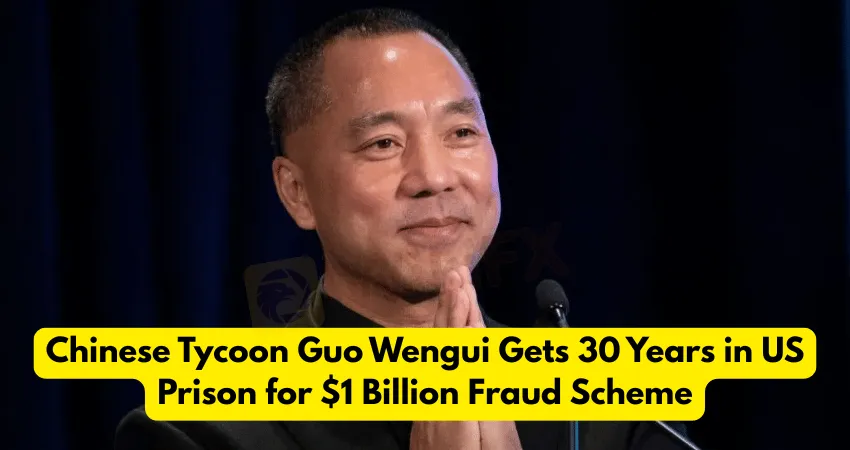
A man who once ranked among China's wealthiest property developers is now facing three decades behind bars in the United States after being found guilty of orchestrating a massive fraud operation that drained more than one billion dollars from thousands of followers who believed they were supporting a pro-democracy movement.
Guo Wengui, also known as Miles Guo and Ho Wan Kwok, was sentenced by New York judge Analisa Torres, who stated that he had deliberately targeted individuals who genuinely wanted to see democratic reform in China, exploiting their idealism to bankroll a lifestyle of extraordinary excess. The sentence marks the end of a legal saga that has captivated both political observers and financial fraud watchers across multiple continents.
Guo's story is one of the more remarkable reinventions in recent memory. Before leaving China in 2017, he had accumulated enormous wealth through real estate development and cultivated ties with senior figures inside the Chinese government. That changed when he found himself facing corruption accusations from Chinese officials, prompting him to seek asylum in the United States. Rather than fading into obscurity, Guo pivoted sharply, positioning himself as a fierce critic of the Chinese Communist Party and building a devoted online following, particularly among Chinese diaspora communities in America.
It was within this space that prosecutors say the fraud took root. Between 2018 and 2023, Guo allegedly raised more than one billion dollars from his online supporters through a series of investment and cryptocurrency ventures. His followers, many of whom were drawn to him because of his political messaging, poured money into these schemes under the belief that they were both investing and contributing to a broader mission of political resistance.
What the money actually funded, according to prosecutors, was a lifestyle of staggering indulgence. Among the purchases tied to Guo were a 50,000 square foot mansion, a luxury Lamborghini valued at one million dollars, and a yacht with a reported price tag of 37 million dollars. The contrast between his public persona as a champion of ordinary people fighting authoritarianism and his private spending was central to the prosecution's case.
US Attorney Sean Buckley noted that despite the many legitimate avenues available to someone of Guo's profile and resources, he chose instead to exploit the trust of thousands of families for personal enrichment. Buckley emphasised that the sentence sends a clear signal that neither celebrity status nor financial clout provides immunity from accountability.
Guo's legal team has pushed back strongly. His lawyer Melinda Sarafa described the 30-year sentence as excessive and argued that it does not adequately reflect the position of thousands of investors who have stated they do not consider themselves victims of fraud. Guo himself has maintained his innocence throughout, insisting that the funds he raised were directed toward his political activism rather than personal gain. An appeal of both the conviction and the sentence is expected.
The case also intersects with a notable political figure. Guo had established a close association with Steve Bannon, a former adviser to US President Donald Trump. The two appeared together regularly in online videos and co-founded a campaign in 2020 called the New Federal State of China, which declared its aim of dismantling the Chinese Communist Party. Bannon was later arrested aboard Guo's yacht in Connecticut, though on charges unrelated to the Guo fraud case. He subsequently entered a guilty plea to a fraud charge connected to a scheme involving funds raised to build a wall along the US-Mexico border and received a conditional discharge of three years. Separate federal charges against him were halted after Trump issued a pardon during the final hours of his first presidential term.
For those who lost savings to Guo's schemes, the conviction and sentence represent a form of reckoning, even as the appeal process begins. The case is a reminder of how political identity and financial fraud can become deeply intertwined, and how movements built around genuine grievances can be weaponised to serve the interests of those at the top.

Disclaimer:
The views in this article only represent the author's personal views, and do not constitute investment advice on this platform. This platform does not guarantee the accuracy, completeness and timeliness of the information in the article, and will not be liable for any loss caused by the use of or reliance on the information in the article.
WikiFX Broker
Latest News
Maybank Completes Malaysia's First Tokenised Financing Deal
WikiFXXM Review 2026 for India: RBI Alert, Regulation, Login and Forex Risk
WikiFX18.3 Million Malaysians Participated in National Anti-Scam Campaign
WikiFXFXGM Review: A KNF Warning and Withdrawal Complaints to Check Before You Deposit
WikiFXExness Review 2026 for India: RBI Alert, Regulation, Login and Forex Risk
WikiFXAustralia dollar on longest weekly winning streak since 2020
WikiFXReview 2026: FBS Complaints, Regulation, and Withdrawal Risk Signals
WikiFXTraders Home Review: Is Your Deposit Safe?
WikiFXA Tiny USDT Transfer Could Put Your Crypto Wallet Under Scrutiny
WikiFXRoboForex Review: Regulation Alarms Hit a Broker Facing Profit-Wipe Complaints
WikiFX