Abstract:Asian stocks fell the most in two weeks on Monday as concern about rapid U.S. rate rises and slowing growth rattled investors, while the euro found support after Emmanuel Macron won a second term as French president.
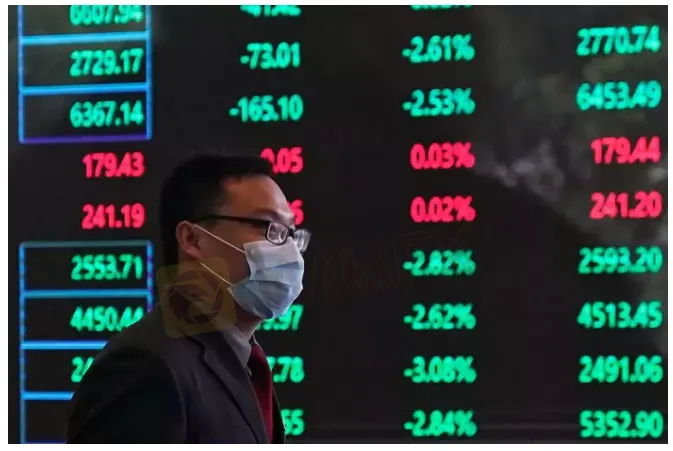
European stocks slid to a one-month low and commodity prices dropped on Monday on renewed concerns about rising interest rates and Chinas sputtering economy, while Wall Street shares rose, reversing losses after Twitter agreed to be bought by billionaire Elon Musk.
Fears over China‘s COVID-19 outbreaks spooked investors already worried that higher U.S. interest rates could dent economic growth. U.S. shares were lower throughout most of the session, extending last week’s sharp declines. The CBOE Volatility index known as Wall Streets fear gauge, hit the lowest level since mid-March.
Twitter Inc shares rose on news that Elon Musk, the worlds richest person, clinked a deal to pay $44 billion cash for the social media platform populated by millions of users and global leaders.
After news of the deal, Wall Street reversed course on a late rally by growth stocks, and the Nasdaq ended sharply higher.
The Dow Jones Industrial Average rose 0.7% to end at 34,049.46 points, while the S&P 500 gained 0.57% to 4,296.12.
The Nasdaq Composite climbed 1.29% to 13,004.85.
“You can tell growth wanted to rally all day but the market was holding it down. The Twitter news came and that was just a green light to start buying some of the growth names. They have been oversold for a while,” said Dennis Dick, a trader at Bright Trading LLC.
Earlier, Europes STOXX 600 index dropped 1.8% to close at its lowest since mid-March. Commodity stocks slumped 6%, as global worries overshadowed relief from French presidential results on Sunday which saw Emmanuel Macron edge past far-right challenger Marine Le Pen. [.EU]
MSCIs benchmark for global equity markets fell 0.41% to 668.85. Emerging markets stocks fell 2.61%. Overnight, Asian markets had their worst daily decline in over a month on fears Beijing would go back into a COVID-19 lockdown.
“Stocks‘ rebound from the first quarter correction has hit a wall of rising long-term interest rates,” Morgan Stanley’s Chief Investment Officer Lisa Shale said in a note.
With the Fed talking about a faster and larger balance sheet reduction than anticipated, real yields are approaching zero from their deeply negative territory. With the nominal 10-year U.S. Treasury cracking 2.9%, the equity risk premium
has plummeted.
The euro slid 0.9%, near the sessions trough and its weakest level since the initial COVED panic of March 2020.
“The reality is there is more to the French election story than Macrons win yesterday,” said Rabobank FX strategist Jane Foley.
France will hold parliamentary elections in June, and Macron also seems likely to maintain pressure for a Europe-wide ban on Russian oil and gas imports, which would cause near-term economic pain.
“We had German officials saying last week that if there was an immediate embargo of Russian energy then it would cause a recession in Germany. … that would drag the rest of Europe down and have knock-on effects for the rest of the world,” Foley said.
Graphic:FRANCE-ELECTION French presidential elections- https://graphics.reuters.com/FRANCE-ELECTION/zgpomlkkqpd/graphic.jpg
State television in China had reported that residents were ordered not to leave Beijings Chatoyant district after a few dozen COVID cases were detected over the weekend.
Chinas yuan skidded to a one-year low while China stocks saw their biggest slump since the pandemic-led panic-selling of February 2020. [.SSE]
The dollar index rose 0.65% and climbed to a two-year high. It touched a peak of $1.0695 against the euro. [FRX/]
Investors wonder how fast and far the Federal Reserve will raise U.S. interest rates this year and whether that and other global strains will tip the world economy into recession.
This week will be packed with corporate earnings. Almost 180 S&P 500 index firms are to report. Among big U.S. tech companies, Microsoft and Google report on Tuesday, Facebook on Wednesday and Apple and Amazon on Thursday. [.N]
In Europe, 134 of the Stoxx 600 will put out results, including banks HSBC, UBS and Santander on Tuesday, Credit Suisse on Wednesday, Barclays on Thursday and NatWest and Spains BBVA on Friday. [.EU]
“I wonder whether just meeting expectations will be enough, it just feels like maybe we‘ll need a bit more,” said Rob Carnell, ING’s chief economist in Asia, referring to jitters about big tech following a dire report from Netflix last week.
Graphic: World stocks suffering one of worst ever starts to a yea- https://fingfx.thomsonreuters.com/gfx/mkt/znvnemkzapl/Pasted%20image%201650875843804.png
FEAR FACTOR
Hong Kongs Hang Seng fell 3.7% and the Shanghai composite index slid over 5% [.SS].
China‘s central bank had fixed the mid-point of the yuan’s trading band at its lowest level in eight months, seen as an official nod for the currencys slide, and the yuan was sold further, to a one-year low of 6.5092 per dollar.
The higher dollar pushed spot gold 1.7% lower by 4:53 p.m. EST (2053 GMT). U.S. gold futures settled nearly 2% lower at $1,896. Palladium prices were down nearly 10% on worries over Chinese demand.
In oil, Brent crude closed 4% lower at $102.32 a barrel and U.S. crude settled down 3.5% at $98.54, its first close below $100 since April 11. [O/R]
Euro zone bond yields fell.[GVD/EUR][US/]
Money markets are pricing in a 1 percentage point increase in U.S. interest rates at the Feds next two meetings and at least 2.5 points for the year, which would be one of the biggest annual increases ever.
This week will also see the release of U.S. growth data, European inflation figures and a Bank of Japan policy meeting, which will be watched for any hints of a response to a sharp fall in the yen, which has lost 10% in about two months.